SAFEGUARDING

Called to Serve
"Defend the weak and the fatherless; uphold the cause of the poor and the oppressed. Rescue the weak and the needy; deliver them from the hand of the wicked." (Psalm 82:3-4)
SAFEGUARDING COMMITMENT
We hold zero-tolerance to all forms of abuse to ensure the safety and protection of children and vulnerable people. Grounded in our faith, we are committed to safeguarding everyone involved in our activities, ministries and services, and to upholding the highest moral, legal, and ethical standards in creating a community where harm is neither ignored nor tolerated.
CATHOLIC DIOCESE OF BUNBURY - CODE OF CONDUCT
PURPOSE
This document contains the Catholic Diocese of Bunbury (Diocese) Code of Conduct (Code)
for the Chancery and Parishes. The Code is to set the standards of conduct, professional and
personal behaviour required by clergy, religious, employees and volunteers of the Diocese.
Click here → CATHOLIC DIOCESE OF BUNBURY – CODE OF CONDUCT
CODE OF CONDUCT SHORT FORM
Purpose
The Code is to set the standards of conduct, professional and personal behaviour required bythe Diocese.
Click here → SGG11 – Code of Conduct – Short Form (Easy English)
COMPLAINTS HANDLING POLICY
INTRODUCTION
Safeguarding is at the core of the mission of the Catholic Diocese of Bunbury. The Diocese upholds theinherent dignity and fundamental right of every person, especially Children and Adults with Vulnerabilities, to feel safe and protected.
Catholic Diocese of Bunbury (the Diocese) is committed to effective complaint handling.
We value the feedback that complaints can provide to improve our organisation’s services and supports to the community.
We aim to empower people to communicate their concerns and complaints without fear of retribution or discrimination by providing a transparent and responsive complaint-handling process. All complaints will be dealt with in a way that observes the principles of honesty, transparency and fairness. Complaints that involve disclosures of abuse or harm will be dealt with in a compassionate, trauma-informed and victim-centred manner that prioritises the safety and wellbeing of children and adults experiencing vulnerabilities.
We will try to resolve concerns and complaints as efficiently and effectively as possible, having regard to the seriousness of the complaint and any statutory obligations we may have to cooperate with other organisations, including police, child protection authorities and oversight and regulatory bodies.
This Safeguarding Complaint Management Policy establishes the overall framework by which the Diocese will welcome and respond to safeguarding complaints. It outlines the key principles and processes that inform our handling of complaints, as well as other sources of guidance signposted throughout, but does not provide detailed procedural guidance about the investigation of complaints as procedural guidance will be dependent of the nature of the complaint.
CLICK HERE → SAFEGUARDING COMPLAINTS MANAGEMENT POLICY
CLICK HERE → Procedure – Complaint Management
MANAGING A PERSON OF CONCERN IN A PARISH
Inform the Person of Concern (PCON) that following the Assessment, if suitable, there will be a meeting with Safeguarding Coordinator, Parish Priest and that the PCON must participate in an Individual Safety Agreement (ISA). The ISA is an agreement between the PCON, the Parish Priest and, if applicable, other people involved in holding the PCON accountable. The ISA must always identify a person responsible for supervising the PCON while present at the Parish.
Click here → Procedure – Managing a Person of Concern in a Parish
MANDATORY REPORTING
If you are a Mandatory Reporter and the allegation is that a child is suspected of being the subject of sexual abuse or is the subject of ongoing sexual abuse; a Mandatory Report is required.
Click here → Procedure – Mandatory Reporting
MASTER POLICY
This Policy is grounded in scripture, theology, and human rights principles, and is informed by both national and state child-protection and safeguarding frameworks. It outlines the Diocese’s coordinated approach to prevention, response, compliance, and continuous improvement, and should be read alongside the Diocese’s wider safeguarding resources and Code of Conduct. The Diocese is dedicated to safeguarding emotional, physical, and spiritual wellbeing, safety, and dignity of every person, with particular care for Children and Adults with Vulnerabilities. “In this regard…there can be no tolerance for any form of abuse in the Church”, Pope Leo XIV October 2025
uses it solely to describe circumstances in which additional safeguarding considerations are necessary, rather than to define or label a person. This Policy must be read alongside the supplementary documents developed by the Diocese (see
Annexure A “Governance Framework”).
MEDIA AND COMMUNICATIONS POLICY
BACKGROUND AND PURPOSE
This policy is designed to ensure that prompt, consistent and accurate responses are developed by the Diocese of Bunbury relating to matters which are of public interest to ensure that all communication is in line with the mission and ethos of the Diocese and the Church.
The policy outlines a process to ensure all media releases, publications, statements and enquiries regarding the Diocese of Bunbury are managed professionally and ethically.
In order to develop consistent, accurate and pastoral communication, it is important that specific issues are coordinated by authorised personnel and communicated by appropriate spokespersons. This applies to all written and verbal correspondence as well as in the media (print and digital).
SCOPE
This Policy applies to ALL Parishes, Agencies, Organisations and Offices of the Diocese.
This Policy does NOT apply to Catholic Schools or Catholic Incorporated Associations or Organisations that are governed and administered under separate legislative or regulatory frameworks.
PROCEDURES
- The official spokesperson for all communication and media emanating from the Diocese of Bunbury is the Bishop of Bunbury. This includes all parishes and agencies associated with the Diocese of Bunbury.
- The Bishop of Bunbury may delegate this to another person or agency from time to time.
Media Releases and Enquiries
- All comment to external media is to be coordinated through the Media Manager for the WA Province of Bishops as a first point of contact. The Media Manager can be contacted via the Diocese of Bunbury Office.
Media organisations who would like comment from the Bishop of Bunbury, any member of Episcopal Council or the Chancellor and Executive Director, Chancery, are requested to direct all enquiries to the Media Manager
|
|
4. If the Media Manager is unavailable, then the matter is to be referred to the Vicar General.
Internal Communication
- Responsibility for all internal communication for the Diocese of Bunbury is delegated to the Vicar General of the Diocese of Bunbury.
- The Vicar General may liaise with other individuals or agencies as required.
- The Vicar General shall be responsible for the approval of content, including written copy, photographs, artwork video and audio.
- Content sourced from other organisations must be appropriately attributed to the organisation, journalist, and/ or publication.
NATIONALLY COORDINATED CRIMINAL HISTORY CHECK
All Workers (including prospective Workers) are required to undergo a Nationally Coordinated Criminal History Check and obtain a National Police Certificate.
Click here → Procedure – Nationally Coordinated Criminal History Check
REPORTABLE CONDUCT
If the conduct constitutes allegations of child sexual abuse, Mandatory Reporters must also
make a Mandatory Report to the Department of Community Services.
If the person making the report is not a Mandatory Reporter, they shall report to Safeguarding Policy.
Click here → Procedure – Responding to Reportable Conduct
RISK ASSESSMENT PROCEDURE
The Bunbury Catholic Diocese is committed to the safety and wellbeing of all individuals involved in events or activities.
The following Risk Assessment Guidelines will assist you when arranging an activity or event within your parish to ensure it runs smoothly, and to ensure the safety and wellbeing of all individuals involved.
Click Here → Procedure – Completing Risk Assessments
DOWNLOADABLE POSTERS
RISK CHECKLISTS
This Safeguarding Risk Checklist is designed to assist Diocesan Parishes, Agencies, Offices, Organisations and Ministries when planning or reviewing activities and events. It helps to identify potential risks, assess and respond.
Referto the Safeguarding Master Policy 15 – Conducting Risk Assessments for further information.
Click here → Safeguarding Risk Checklist -Childrens Activity or Event
Click here → Safeguarding Risk Checklist 1 -Community or Adult Activity or Event
Click here → Safeguarding Risk Checklist – Home visits
SCREENING GUIDELINE
SCREENING REQUIREMENTS FOR ALL WORKERS ENGAGED IN CHILD RELATED ROLES IN THE DIOCESE OF BUNBURY.
There is important legislation that provides protection of children and assists to provide regulation for all organisations that work with Children. In WA, legislation includes the Workingwith Children (Screening) Act 2004, Children and Community Services Act 2004 and Parliamentary Commissioner Amendment (Reportable Conduct) Act 2022. These legislative requirements apply to all workers at all Parishes/Agencies/Chanceries of the Diocese of Bunbury. This document provides information on a worker’s legal obligations and responsibilities to better protect children and young people, and guide on requirements for each role. (CLICK FOR MORE) → Screening Guideline
TRAINING AND REQUEST FORM
Safeguarding Training is now available through ACSL Learning Platform. To request enrolment, please complete this form.
Training course available include:
- Safeguarding Essentials – NEW
- Introduction to Safeguarding (Formerly Level 1 Induction Training)
- Safeguarding Refresher – NEW
- Parish Safeguarding Coordinators (Formerly Level 2 Training)
- Safeguarding Adults at Risk – NEW
- Safeguarding Risk Management – NEW
Please contact safeguarding@bunburycatholic.org.au for more information or assistance with enrolment.
Click here → Form – Safeguarding Personal Declaration
Click here → SGG12 – Form – Safeguarding Consent Form
EASY ENGLISH REPORTING INFORMATION SHEET
The Safeguarding of children, young people and adults at risk is the collective responsibility of everyone in our Catholic community. A report can be made by a child, parent, member of the community, church representative or any other person or witness.
Click here → Reporting Process
QR CODE
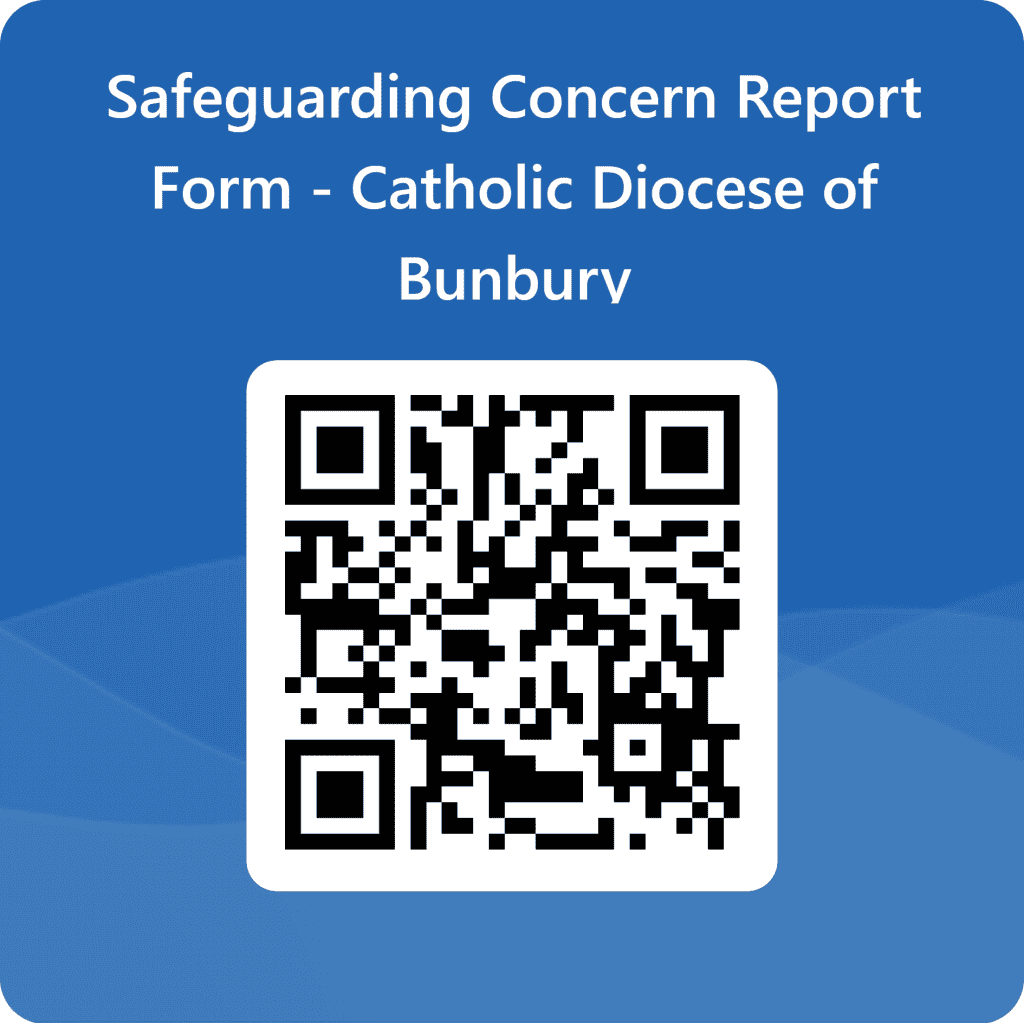
QUICK LINK
Safeguarding Concern Report Form
IF YOU HAVE CONCERNS FOR THE IMMEDIATE SAFETY OF A CHILD OR ADULT CALL 000.
It is a legal requirement in WA for Ministers of Religion to report child sexual abuse to the Department of Communities’ Mandatory Reporting Service. If you are a Minister of Religion, please contact Safeguarding Coordinator for additional advice.
The Catholic Diocese of Bunbury is to comply with the Reportable Conduct Scheme to report Reportable Conduct and Convictions by notifying the Ombudsman of any allegations of, or convictions for, child abuse by our employees (paid/volunteer, contractor, ministers of religion or others).
For further information or if you require support to complete this report, please contact the Safeguarding Coordinator on (08) 97210517 or safeguarding@bunburycatholic.org.au
FOLLOW THE LINK → Safeguarding Concern Report Form – Catholic Diocese of Bunbury – Fill out form
CONTACT INFORMATION

SAFEGUARDING NOMINATION FORM
SAFEGUARDING OFFICER JDF
This position is responsible for ensuring that the parish is aware of the importance of safeguarding and supporting the fundamental obligation of Catholic Diocese of Bunbury to ensure the proper safeguarding of children and adults with vulnerabilities.
This position will work closely and in cooperation with Diocese Safeguarding Coordinator.
Click here → Parish Safeguarding Volunteer role description – DRAFT
FEEDBACK AND SURVEY FORM
FEEDBACK QR CODE
All visiting Clergy, Deacons, vowed Religious and lay, who wish to engage in public ministry within the Diocese of Bunbury must filled up the following documents below:
The application for permission must be received at least two weeks prior to the commencement of the appointment/visit.
If you have an ACMR, please complete only the Safeguarding Personal Declaration Form.
If you are not the holder of an ACMR, you will need to complete both the Safeguarding Personal Declaration and have the Church Authority Statement Form
Forward the required form/s to safeguarding@bunburycatholic.org.au
For a full overview of the process – Procedure – Visitors (Clergy, Religious and Lay People) (same click to download as you already have)
CLICK TO DOWLOAD → Form – Safeguarding Personal Declaration
CLICK TO DOWLOAD → Form – Safeguarding Church Authority Statement
CLICK TO DOWLOAD → Procedure – Visitors (Clergy, Religious and Lay People)