Catholic Education (CEWA)

Alphabetical selection of school town

Christ-centred, child-focused community

Catholic schools and colleges place emphasis on the potential of every student. In preparing for emerging challenges facing young people in an ever-changing world, our schools and colleges offer diverse academic programs and learning pathways. Our aim is to support all students to think independently and learn to know, love and respect themselves and others. Our schools embrace Christian virtues and are communities of hope where students, staff and families are treated with dignity and respect. The challenge for Catholic schools is to radiate hope for the future of all students. It is to embrace Gospel messages and values in each of our classrooms; bringing to life the joy of learning, a spirit of service and a culture of excellence. In the words of John Paul II, we are called on “to be people who live with gratitude for the past, enthusiasm for the present and hope for the future”. Welcome to Catholic Education Western Australia.

Purpose

To provide a safe learning environment, illuminated by faith, in which all students thrive.


Vision

To provide quality education for our students and the wider community

To provide a faith filled learning experience for our students

That all staff will have a shared belief and understanding regarding effective teaching and learning practices


Promises 

Staff will model their behaviour on the person of Jesus

All students will develop their physical, spiritual, emotional and intellectual capabilities

Parents, parish and the wider community will be involved in the educational experience offered by the school


Core Values “Concern”

Concern for God

Concern for others

Concern for self


Our History

St Patrick’s School was established in 1926 with the arrival in January of that year, of three Our Lady of the Missions sisters. The school opened on 3rd February at 9.00am with 47 pupils, and the first classes were originally located in the Church. The school finished that year with 108 pupils. The sisters continued to teach in the Church until 1927. By then, three rooms and a verandah were built in the Church grounds, and these were opened and blessed by Archbishop Clune on 5th December 1927. These classrooms faced Annie St, and are currently the School Hall and Canteen. In 1958, two additional rooms were added, facing Amherst St, and these currently house Years 5 and 6. 1966 saw the building of the Parish Hall.

St Patrick’s School continued to grow rapidly and the building of additional classrooms, (currently Years 1, 2, 3 and 4) were completed and opened in 1975. In 1988, the current Administration Area was constructed, and 1993 saw the completion and opening of the purpose-built Pre-Primary Centre. The most recent Building Programme, including a new classroom, a dedicated Multi-Purpose Room for the Arts, and a large Covered Area, was completed in 2004. The national BER program supported St Patrick’s with a build of a new library and administration block. More recently, the school completed the re-development and refurbishment of the Pre-Primary, Year One and toilet block area.

St Patrick’s School now operates composite classes catering for children from Kindergarten through to Year 6. There are currently 84 children attending the school with a staff of 13 comprised of 7 teachers (full-time and part-time) and 6 non-teaching staff. The staff is hard working and committed to providing a high level of pastoral care and quality education to their students.

School Crest

The crest is dominated by the symbol of the cross. This is the sign of our Christian faith – the “Victory of Christ”. It also acts as a reminder of the Gospel values that are taught, and lived within the school.

Our Factions

Prendiville Faction

Named in honour of Archbishop Redmond Prendiville, Archbishop of the Perth Archdiocese from 1935- 1968. Archbishop Prendiville was a visionary man who oversaw the rapid expansion and development of Catholic schools throughout Western Australia. Archbishop Prendiville was responsible for the capital developments that took place in parishes, and the building of schools and churches, so that Catholic education could be accessed by so many, during these years. He was said to have had a dynamic personality and a keen drive to accomplish all tasks, with excellence as his only standard. He made visitation trips to Katanning on several occasions, and many of the staff who have taught at St Patrick’s were educated themselves in colleges that were developed during Archbishop Prendiville’s time.

McLeod Faction

Named in honour of Sr Mary Bernadette McLeod, a former St Patrick’s teacher, of the order of Our Lady of the Missions. Sr Bernadette had also been a student at St Rita’s Convent (later, St Patrick’s School ) and lived in the large imposing home on Clive St, that is now owned by the Ogden Family. Sr Bernadette’s father, was a prominent member of the then Katanning Roads Board (Shire) and President at times.

Prior to the existence of St Rita’s, Sr Bernadette had been educated at the government school, but children always made their way back to her home after school to enjoy many happy hours of play.

Sr Bernadette is remembered by some of St Patrick’s parishioners for her firm, but fair discipline and her passion for educating young people with encouragement and a desire to achieve greatness in all that was tackled.

Gibney Faction

Named in honour of Bishop Matthew Gibney, Bishop of the Perth Archdiocese, from 1889-1910. He layed the foundation stone of the first Roman Catholic Church in Katanning. Bishop Gibney had actively encouraged the local priest, Father Duff, in his tireless efforts to build a Church in Katanning. It was to become the first Catholic Church located between Albany and Beverley.

Bishop Gibney promptly donated fifty pounds and arranged a loan of a further fifty pounds towards the estimated six hundred pounds that was needed to complete the project.

Bishop Gibney was known as a keen sportsman, with a particular interest in golf. Whilst holidaying in Victoria, Bishop Gibney encountered the drama of Glenrowan and Ned Kelly’s last stand. Bishop Gibney did not administer the last rites to Ned Kelly, as has been rumoured, but certainly was warned by Ned not to approach the burning buildings, for fear that he would be mistaken by other gang members as a trooper, and would be shot. Bishop Matthew Gibney, was laid to rest in 1925 at his request, in St Mary’s Cathedral Perth. Recent renovations to St Mary’s Cathedral in Perth, brought this resting place to prominence.


VISION

Through the community of students, staff, parents and parish, we strive to provide each child with the desire and opportunity to reach his/her highest potential: spiritually, emotionally, intellectually and physically, in an environment which reflects strong Christian values.

St. Bernard’s is a co-educational school and caters for students from Kindergarten to Year 6 in
composite classes.
St. Bernard’s is a growing school, keeping pace with technology, the West Australian Curriculum and
practices. Our practice involves the identification of needs and appropriate intervention for all students
through effective use of student data, reflective and collaborative teaching and excellence in pedagogy.

Some key elements of our school:

• St. Bernard’s provides a broad and balanced curriculum that caters for the needs and talents of
all students.
• St. Bernard’s strength is it’s strong, meaningful and valuable partnerships between home,
school and the wider community. There is honest, respected and effective communication
ensuring that the best possible outcomes are achieved for all students.
• St. Bernard’s has a long tradition of catering for students with special needs.
• St. Bernard’s seeks to create environments that enhance learning, nurture young people and
empower them to live the Catholic faith in the Spirit of Jesus Christ.
• St. Bernard’s represents all the qualities of a small country school.
• St. Bernard’s staff are experienced and up to date with today’s educational standards. Through
Professional Development, all staff keep current with the most recent educational
developments.
• We aim to instill a sense of self-worth, responsibility, respect for others and an ongoing love of
learning

Our History

St. Bernard’s was established in 1952 by the Sisters of Mercy, who ran the school until 1986. The school has undergone a number of changes, most recently a complete upgrade of the Kindy/Pre-Primary playground and moving our Year 3/4 classroom to a more modern and much larger building. St. Bernard’s is an integral part of the town of the Kojonup, being one of the longest surviving institutions and responsible for the primary school education of many within the local community.

VISION

It is our vision to grow young people with strong minds and gentle hearts; people of hope, demonstrating through their actions, compassion and humility.

STRONG MIND

“Be strong and courageous. Do not be afraid; do not be discouraged, for the Lord your God will be with you wherever you go” Joshua 1:9

People of Strong Mind, in the St Marcellin Way seek God. They are hope filled and show a spirit of gratitude. God chose St Marcellin Champagnat to bring hope and the message of Jesus to young lives in the France of his day. It is our hope that our young people will bring a spirit of hope to their lives.

Strong minded people seek courage and practice commitment. They are resilient and adapt to challenges. They are optimistic, seeing setbacks as temporary, changeable, and related to their present circumstance.

Strong minded individuals are lifelong learners with a strong sense of purpose for their lives. They are always learning and growing and are seekers of knowledge, as was, St Marcellin Champagnat.


Gentle Hearts


“Be completely humble and gentle; be patient, bearing with one another in love” Ephesians 4:2

Gentle Hearts should be read alongside Strong Minds. There cannot be one without the other. People with gentle hearts, use their words with care. They extend grace and forgiveness to others as Gospel values, and they prioritise relationships and connectedness. They are compassionate. A gentle heart is a humble heart. Those of gentle heart are tender and demonstrate warmth and consideration for those around them. Gentle hearts operate at their best in community and for community.

In putting others first, they are not de-prioritising the self, but rather, they understand that in loving others, they flourish!


Hope


God chose St Marcellin to bring hope to young lives in the France of his day. For us, hope is a human strength that enables us to hold great promise for our lives. It is how we feel peace and joy. Hope gives us a way forward and is seen as the foundation in helping us to achieve our dreams and ambitions.

Humility

As one of his three most special virtues, St Marcellin valued humility immensely. For us, it is the honest recognition of our own worth as God sees us. Humility doesn’t mean hiding our talents, it means accepting our own limitations and having the capacity to see the contributions of others.

Compassion

Compassion is the capacity to put love into action. It reflects God’s heart, and it is a tangible expression of love for those in need. Compassion gets involved! Our restorative practices at St Marcellin reflect our value on compassion. It underpins all interactions in our College community.


Our Faith Story

The Catholic story has its heart in Jesus Christ and his values of love, compassion, and faithfulness. With Catholic Social Teachings at our heart, we value the human dignity of all, whilst honouring the common good.

Guided by Catholic Education Western Australia and Quality Catholic Education, it is the vision of our system to build schools and classrooms that are Christ centred, and child focused, inspiring all to actively live the Gospel.

At St Marcellin Catholic College we make a commitment that our College will, with Christ as the foundation, place the spiritual, physical and mental wellbeing of each person as a priority.

The Marist Story

The Marist story centers on the person of St Marcellin Champagnat, who inspired by Mary, sought to ‘make Jesus known and loved.’

St Marcellin was a man of hope, with a deep humility, and a great faith.

The story of this young priest takes us back to late eighteenth century France. As a founder of the Marist Order, Marcellin was young, aged only 27 years when he asked his first recruits to join him. He gave his little brothers a clear mission, proclaim the Word of God directly to the young, and among them, to those most neglected. He knew that to teach young people, you had to love them first.

Marcellin guided his life and work by that principle, and he expected his brothers to do the same.

portrait of a man

College Naming

At St Marcellin Catholic College, it is our intention to immerse ourselves in this incredible story and in our own way, to walk his roads, envisage the terrain he so loved and meet the people who shaped him.

Our buildings and spaces will be named after places and people of significance in Marcellin’s world.

Our School Spirit

Faith | Community | Learning | Service

Our school is founded in the spirit of the Presentation Sisters. A sense of pride and joy abounds in our flourishing learning community, where the whole community aspires daily to our school motto ‘United in Christ’.

Our ‘Make Jesus Real’ program brings our Catholic faith to life in our school by showing our children how to live it every day. We have a close relationship with the parish, with our children undertaking the Sacraments of Reconciliation, Holy Communion and Confirmation through Our Lady’s Assumption Catholic Parish, Mandurah.


What we offer

Engaging Educators
Our innovative educators inspire our children to flourish and reach their full potential through creative, fun and engaging classroom environments.
Inspiring Spaces
With wide open play areas, sensory garden, nature playground, vegetable garden, sacred spaces and expansive ovals; there is a space for everyone.
Embracing Community
The happiness, energy and wellbeing of our community shapes and inspires who we are and who we can become. We are United in Christ.


Mandurah Catholic College emblem with cross and motto Seek Truth.

MISSION STATEMENT

Our College is a learning community seeking truth by living out the Gospel values through the Catholic faith and by promoting the holistic and optimal development of each person.

Mandurah Catholic College (MCC) welcomes you to the family.

Established in 1992, Mandurah Catholic College (MCC) is a co-educational school catering to students from Kindergarten to Year 12 and offering a quality Catholic education. Set amongst 12 hectares of natural bushland in the coastal suburb of Mandurah in the Peel Region, south of Perth, the College caters for over 1700 students and has over 200 members of staff.

The College aims to create a climate where students can grow in their Catholic faith, and Christian values and principles are nurtured. Our patrons, the Holy Family provide inspiration to students and staff, with the family unit and values at the centre of all we do.

The College provides a holistic education with the aim to promote the optimal development of each individual. The College places strong importance on the Pastoral Care of students: their physical, emotional and mental wellbeing are a high priority.

MCC students have access to a broad range of academic, cultural sporting and ministry opportunities, which enriches their learning experience. The College boasts well-resourced facilities and is equipped with the latest technology to enhance student outcomes.

Book in for a College tour, and learn more about how Mandurah Catholic College can be the right fit for your family.

Kearnan College Mission

The Kearnan College Mission is influenced by our founders, the Sisters of St Joseph of the Sacred Heart.

Kearnan College, comprising students, staff, parents, the St Joseph’s Parish and the wider community, seeks to acknowledge the fundamental dignity of each individual. We aim to ensure that each individual is inspired to reach their full potential; to think, to learn, to achieve, to care and to serve.


Kearnan College Vision

Kearnan College is a nurturing, co-educational PK – 12 Catholic community, dedicated to recognising the gifts and talents of every individual inspiring them to reach their full potential.


Our Crest

The symbolic meaning of our crest.

The Cross of faith, the dove for all the gifts of the Spirit and the circle of wholeness, along with the words “Seek Truth”, signify our belief that the way of finding truth is the way of God.

Kearnan College History

The College was founded by the Sisters of St Joseph in 1925 and has a rich history of providing quality education in the Manjimup area for the last 100 years.

The Manjimup-Pemberton Parish was established in 1922 by Doctor Francis Kearnan who was appointed as Parish Priest. He was responsible for the purchase of six blocks of bush land for the establishment of a church school. Early in 1925 Mr Dennehy, a Perth architect, was asked to prepare plans for a two-storey brick boarding school – with four classrooms on the bottom floor and separate dormitories above for boys and girls. Wide balconies and verandahs were included with an eye to future expansion.

Tenders were called for the construction of two of the classrooms and the dormitories, with another small room as a presbytery. The successful tender was submitted by George Ausden a builder from Bridgetown with a cost of 1,650 pounds. Delays in construction were created by building material shortages, but the school was completed and blessed by Archbishop Clune towards the end of 1925.

The original church building, which had been used for services but never appeared to have been consecrated, was purchased by George Ausden when he could not find accommodation for his family whilst in Manjimup. This left the Catholic Community without a church; a problem solved by celebrating Mass in one of the larger classrooms at the school. This solution sufficed until the congregation outgrew the classrooms. An alternative was to enclose the verandas and move the boarders there, leaving room to set up their old sleeping quarters for church services. The Catholic community persisted with this situation until St Joseph’s Church was built in 1955.

In 1961, renovations and extensions of the school were carried out, including new classrooms, roofs being tiled, balconies removed and the hall refurbished. Under Parish Priest Father Stephen Kelly, who was appointed in 1970, the school was upgraded to become a five-year high school and was renamed Kearnan High School. This became WA’s first co-educational Catholic School.


Dr Kearnan, the founder of our College, was a Priest of great vision but also very practical.

He was ordained a Priest in Rome on Easter Saturday 1919 after having attained his Doctorate in Sacred Theology. Only three years later, he was appointed as the first Parish Priest of Manjimup in 1922.

Dr Kearnan had already been travelling to Manjimup by horse and cart to perform Mass once a week and had seen the need for a Parish school. During that time, he contacted Mother Mary MacKillop to request that some Sisters of St. Joseph of the Sacred Heart begin teaching here. Three Sisters arrived in 1921 to begin teaching in the former weatherboard church, which sat on the site of what is now the Town Hall.

With Dr Kearnan’s vision for the future, parishioners were soon helping to build the present school, then named St Joseph’s. The practical application of his skills saw him creating desks and chairs from old packing cases, buying a cow to feed the boarders and building a fence to contain the cow. Dr Kearnan remained as Parish Priest in Manjimup until the 1940s, with the school being named in his honour.

Our Vision

Inspiring life-long learners who live their faith and contribute positively to our world.


Our Moral Purpose

A Christ-centred community developing the whole child with a focus on high expectations and academic success for all students


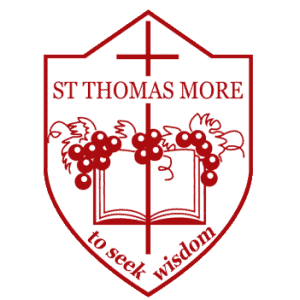
School Crest

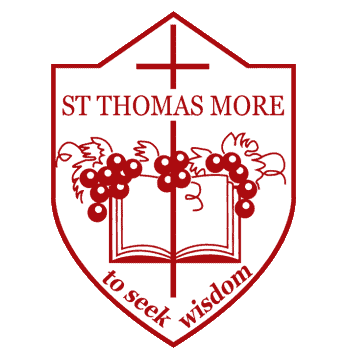
The cross reminds us we are centered in Christ, the book symbolises the learning that takes place at St Thomas More and the vines and grapes reference the Margaret River region.

Our motto – to seek wisdom – reminds us that we are constantly learning and that we must always strive to be like Jesus in our decisions and actions.

School History

As a result of meetings and discussions held in 1948, St Joseph’s Convent School was opened by the Most Rev. Archbishop Prendiville on the 19th March 1950.

The actual building built by the Davies family, was purchased by Fr Farrelly of Busselton for 400 pounds and transported to the Margaret River site.

Responsibility for the Parish of Margaret River was given over to Rev. Fr Sorahan.

Economically the district was struggling but the strong resolve and hard work of the Parents and Friends Association formed in 1950 raised money to purchase the necessary equipment and materials for the school.

For the first time, Catholic parents in the district had an opportunity to send their children to a convent school in their own area. The convent meant that a priest came to stay in Margaret River looked after by the Sisters of St Joseph who were teaching in the school.

The school catered for infants through to students studying for their “Junior Certificate.”

The school had an enrolment of up to eighty students with music, typing and shorthand included in the curriculum offered.

The school operated successfully until its closure in 1970. It wasn’t until the 28th March 1993 that the new school, named St Thomas More Catholic Primary School, was opened by Catholic Education Director, Mrs Therese Temby and blessed by the Bishop of Bunbury, the Most Rev. Peter Quinn.

The foundation Principal was Sr Kathleen Hitchcock who began operations with an intake of students from Pre-Primary through to Year Five.

Stage Two was officially opened and blessed on the 27th May 1995 and Stage Three on the 23rd October 1998. The school has been operating as a co-educational, single-stream facility ever since with an expanded curriculum offering the specialist areas of Indonesian, Visual Art, Physical Education and Music.

The school has a large oval with cricket nets and tiered seating, a Market Garden and chicken pen, numerous play areas, including a Nature-playground and a basketball/netball court. Within the school complex are two large undercover areas and a separate play area for the Kindergarten and Pre-Primary students.