Our PARISHES

Alphabetical selection of parish town

Come Journey with Us

Can. 515 §1. A parish is a certain community of the Christian faithful stably constituted in a particular church, whose pastoral care is entrusted to a pastor (parochus) as its proper pastor (pastor) under the authority of the diocesan bishop.

PARISH RESOURCES

PARISH ADMINISTRATION HANDBOOK → Rpt-Parish-Administration-Handbook-2020

PARISH FINANCE STATUTES → Appendix-A-Parish-Finance-Committee-Statutes

PARISH FINANCIAL REPORT TEMPLATE → Appendix-B-Parish-Financial-Report-Template

PARISH INVENTORY TEMPLATE → Appendix-C-Parish-Inventory-Record-Template

PARISH MAINTENANCE AND SAFETY SCHEDULE →Appendix-F-Parish-Maintenance-Safety-Schedule

PARISH PRIVACY POLICY → Appendix-G-Parish-Privacy-Policy-Template-May-2019

GUIDELINES AND PROCEDURES FOR PURCHASE AND SALE OF REAL PROPERTIES → Appendix-H-Purchase-Sale-of-Real-Property

GUIDELINES AND PROCEDURES FOR BUILDINGS → Appendix-I-Building-of-Parish-Property

CAPITAL AND MAINTENANCE PROGRAM TEMPLATE → Appendix-J-Capital-Maintenance-Program-Template

LEASING PARISH PROPERTY → Appendix-K-Leasing-Parish-Property 

HIRE AND RENTAL OF PARISH PROPERTY → Appendix-L-Hire-or-Rental-of-Parish-Property

STANDARD APPOINTMENT EMPLOYEE LETTER → Appendix-M-Standard-Employment-Appointment-Letter

CONDITIONS OF EMPLOYMENT → Appendix-N-Conditions-of-Employment

NEW EMPLOYEE CHECKLIST → Appendix-O-New-Employee-checklist

PARISH FINANCE AND ADMINISTRATION CALENDAR TEMPLATE → Appendix-P-Parish-Finance-Admin-Calendar


Sunday Mass:

Sunday –  10:30 AM

Weekday Mass: 

Wednesday  – 11:00 AM 

Friday –  9:00 AM

Reconciliation: 
Friday and Sunday  after mass  and by appointment

History 

Several theories are put forward as to the origin of the name of the town. The Aboriginal name Ketaning – the place where the bird known as the Willy Wagtail (Chitty Chitty) nests. The aboriginal Kartanup where “kart” means head and “annup” meeting place, so the head meeting place…for visiting Aboriginals. The history of the parish of Katanning reads like a miniature version of “Gone with the Wind”. So many interesting and historical events, humorous anecdotes, family tragedies and on many occasions shared joys are recorded that some of them are almost unimaginable. The nationalities of the priests are mixed, mainly Irish as were their parishioners and English, Italian, Australian, Polish, Dutch and Filipino. The Catholics of this area, which became known as the “Great Southern”, lived in the districts and towns of Katanning, Kojonup, Gnowangerup, Tambellup, Wagin, Narrogin and down south to Ravensthorpe. In earlier years the priests had to cover these distances on horseback or in a horse and buggy – the latter could only be used if finance was sufficient and there was a track on which to drive.The first Catholic Mass celebrated in the Katanning district was by Fr Matthew Gibney, an Irishman traveling his vast parish on horseback. On one of his visits to an outlying homestead he called at Martinup near Broomehill where the lady fo the house, Anna Maria Norrish Treasure, gave him newly baked scones to ear. Unfortunately she had made a mistake and used arsenic instead of baking powder. The priest nearly died. Another story from Martinup – the marriage of Elizabeth Mary Treasure, eldest daughter of Anna Maria and Edward Treasure, who was to marry James Michael Flanagan. The food was prepared and many guests had arrived, but no priest. It seems he had got lost! So they all got dressed in their wedding attire and had the wedding feast – Father arrived in a few days. The bride got dressed again and Elizabeth and James were married. Fr Gibney was followed by a Frenchman, Fr Matteau. Then came Fr Delaney, another Irishman. He was well known for his poor sense of direction and often became lost. Fr Coll traveled extensively around the district mostly with the sandalwood cutters. He did his best to persuade parents to send their daughters to Albany where a convent was being established. Fr Joseph Chmelicek, a Russian Pole, came to live in a mud hut in the district, his place of residence being situated between Katanning and Kojonup. He died alone in his hut with a rosary in his hand. He was 76 years old when he died in 1890. Fr Reidy had his body exhumed from its burial place near the hut and placed in consecrated ground in the Norrish-Treasure-Jones family portion of the Kojonup cemetery.

Katanning then became a separate parish from Kojonup and the first resident priest was Fr Duff, an Irishman. He was responsible for the first timber church which had an attic over the sacristy where he had his home. Four families were responsible for the construction of the building – Job Haddleton, Cronin, Grover and Noonan were the builders. The building did not have sufficient foundations for the large heavy building and the top part gave way under the excessive weight. 

Katanning is in the centre of the Great Southern area, and is the centre of a wheat and sheep farming district and is primarily an agricultural farming community with its supporting industries. It is a multicultural community with 12 different religious organizations. It is 240kms east of Bunbury and has been a parish since 1880. There is a fine church and presbytery as well as a Catholic school. The priest in Katanning also oversees the parishes of Kojonup and Tambellup, as well as providing Mass in Broomehill as an out station of Katanning. The church in Katanning has St. Patrick as Patron, the church in Kojonup has St. Bernard, the church in Tambellup has St. Michael and Broomehill has Our Lady of Fatima. There is a presbytery in Kojonup and a Parish house in Tambellup. 

PARISH PRIEST
 
Rev. Fr. Marlon Chingwangco
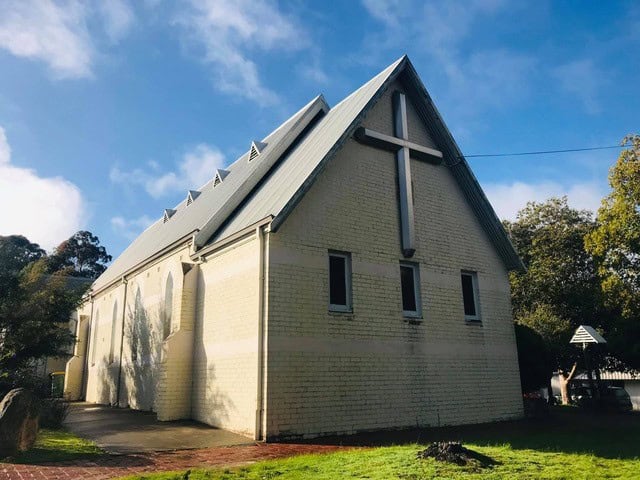
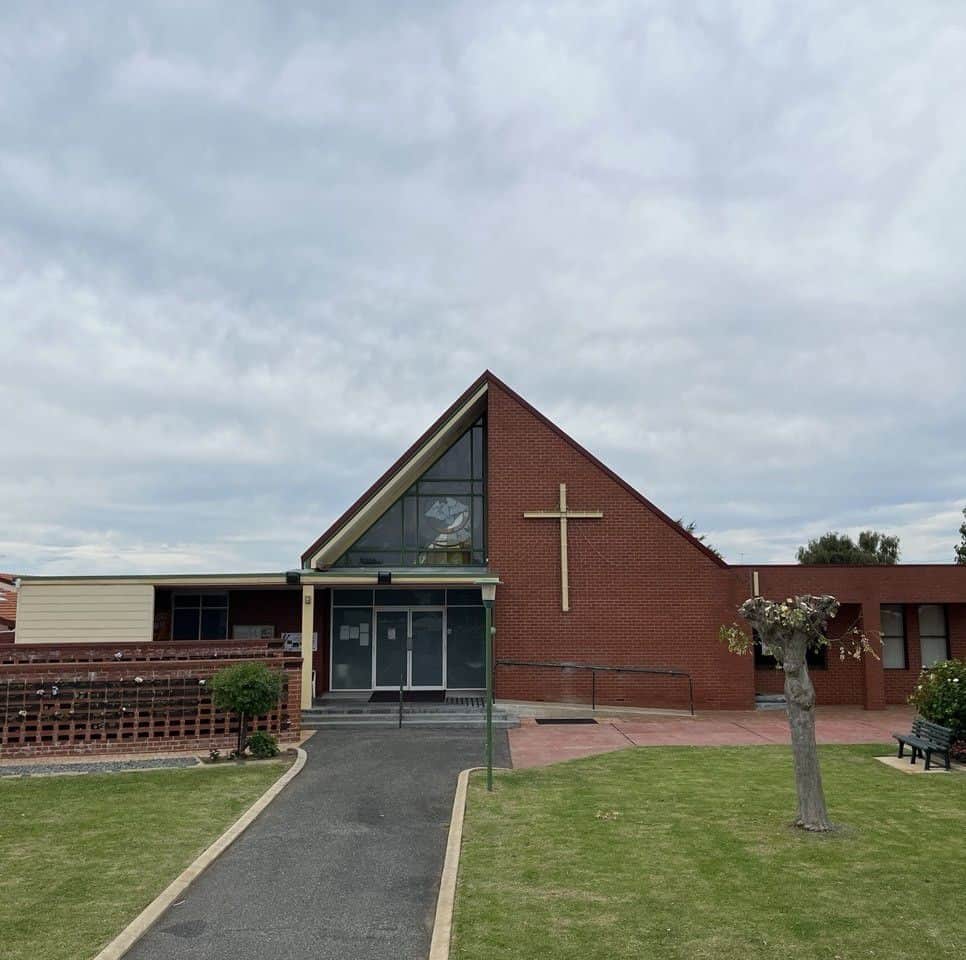
Bunbury Catholic Diocese church building with a large cross on the front.

Sunday Mass:

First, Second, Third and Fourth Sunday –  8:30 AM
Fifth Sunday – Liturgy of the Word with Communion
Reconciliation: 
By Appointment

History

Kojonup Parish 

This Aboriginal name means ‘the place for stone axes”. The town was declared on 4th May 1900. It started as a parish in 1884 and a decade later became part of the Katanning parish and did not become independent again until 1951.

Kojonup was settled in 1837 as a military outpost on the new road between Albany and York. Sheep farmers soon followed the soldiers, bringing the first white families to the area. The spiritual needs of these people were served by Anglican and Catholic clergy, on their travels between Perth and Albany. In 1885, one keen Catholic mother walked to Fremantle with her 12 year old daughter, so she could attend boarding school!

In 1860, the Kojonup Colonial Mixed School was opened, along the lines of the Irish National System. Although opened by the General Board of Education, the first headmistress, Ann Loton, was a devout Catholic and five of the six families were Catholic, so there would have been some “passing on of the Faith”!

On 18th February 1872, Bishop Griver from Perth confirmed 16 people. The first church bazaar was held on 2nd January 1883. All this long before we had a resident priest! That same year, on the other side of the world in Moravia, Fr Joseph Chmelicek felt called to volunteer for missionary work and was accepted by Bishop Griver, who happened to be in Rome at the time. He brought him to WA, and he celebrated his first Mass at Kojonup, as our first Parish Priest, on 3rd February 1984.

Fr Chmelicek was a man of many talents and established himself on a small farmlet which he purchased from the Noonan family, growing vegetables for sale to support himself. His herbal remedies, and his kindly understanding nature were known and respected throughout the district he served, between Williams and Tenterden. It is said that he would read while travelling in his cart, allowing his horse to wander from side to side nibbling the roadside plants at will!

Tragically, in the 1890s, malicious gossip was spread about this kindly man and he received a letter from Bishop Gihney, requesting a meeting with him to discuss the matter Fr Chmelicek was so upset that his Bishop could suspect him of immoral behaviour, that he withdrew from his public life and lived as a hermit in a small mudbrick hut. A crushed and broken man, he was found dead with his Rosary beads in his hands at the age of 76, in 1909. He had never been rejected by the church and was regarded as a retired priest, respecting his wish to be left alone.

St Bernard’s Church was built in 1913, at which time we were part of Katanning Parish Religious instruction for the children was provided by the Bushie’s Schools, run by the Sisters of St Joseph throughout the Great Southern. In 1952, St Bernard’s School was opened by the Sisters of Mercy, who staffed it until 1987. Since then it has been staffed by lay people. In 1955, George and Mary Jeffs purchased a beautiful marble statue of Mary Immaculate and mounted it on a rock on their farm at Jingalup. They initiated the Rosary Rally, which has been held on the last Sunday of October every year since. The statue now resides at the school, since the Jeff’s farm has been sold.

Kojonup was made a Parish by St Bernard’s stained glass windows Archbishop Prendiville in 1951, the PP being Fr Martin Brennan. Fifteen Diocesan Priests have followed him, until 1998, when we will again share a priest with Katanning, whilst remaining a separate parish.

St Bernard’s is entering a new era as part of the Multi- Parish Team, of St Patrick’s, Katanning, St Michael’s, Tambellup and Broomehill parish.

PARISH PRIEST (SAINT PATRICK – KATANNING)
 
Rev. Fr. Marlon Chingwangco
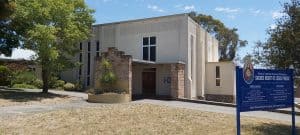
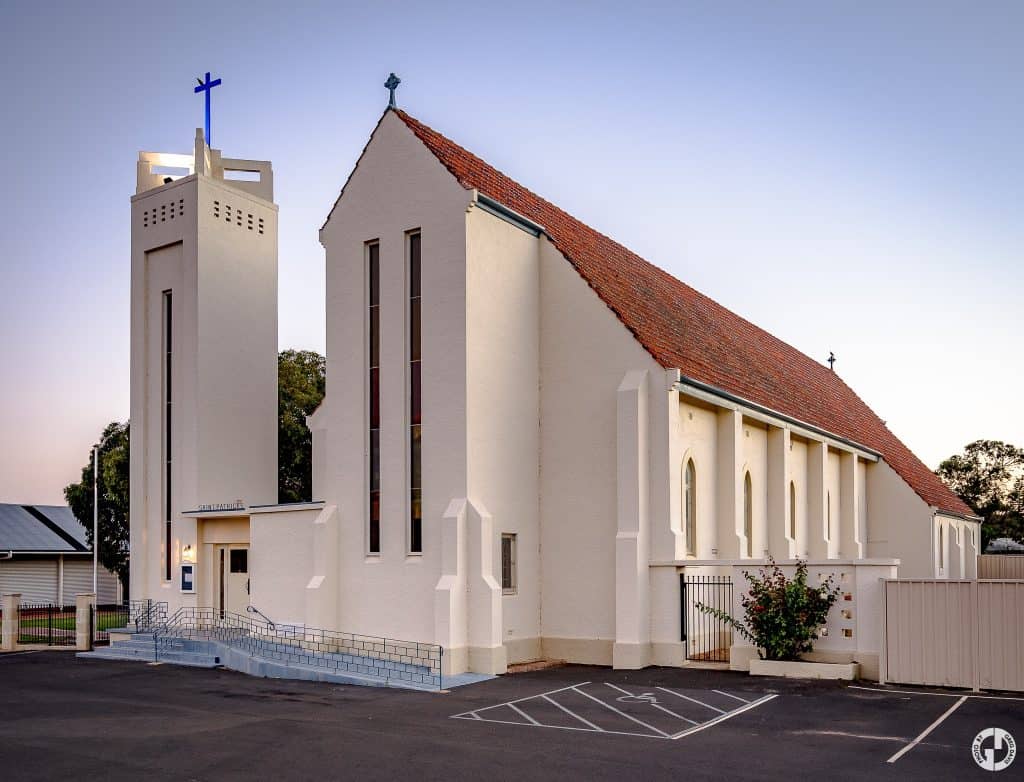
Bunbury Catholic Diocese church building with brick facade and cross on top.

Sunday Mass:

Second Sunday –  10:00 AM
PARISH PRIEST
Rev. Fr. Manoj George Moolamthuruthil, HGN (Resides at Lake Grace)
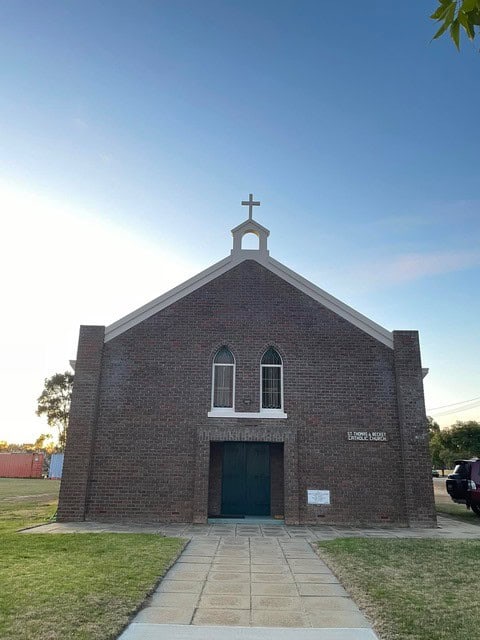
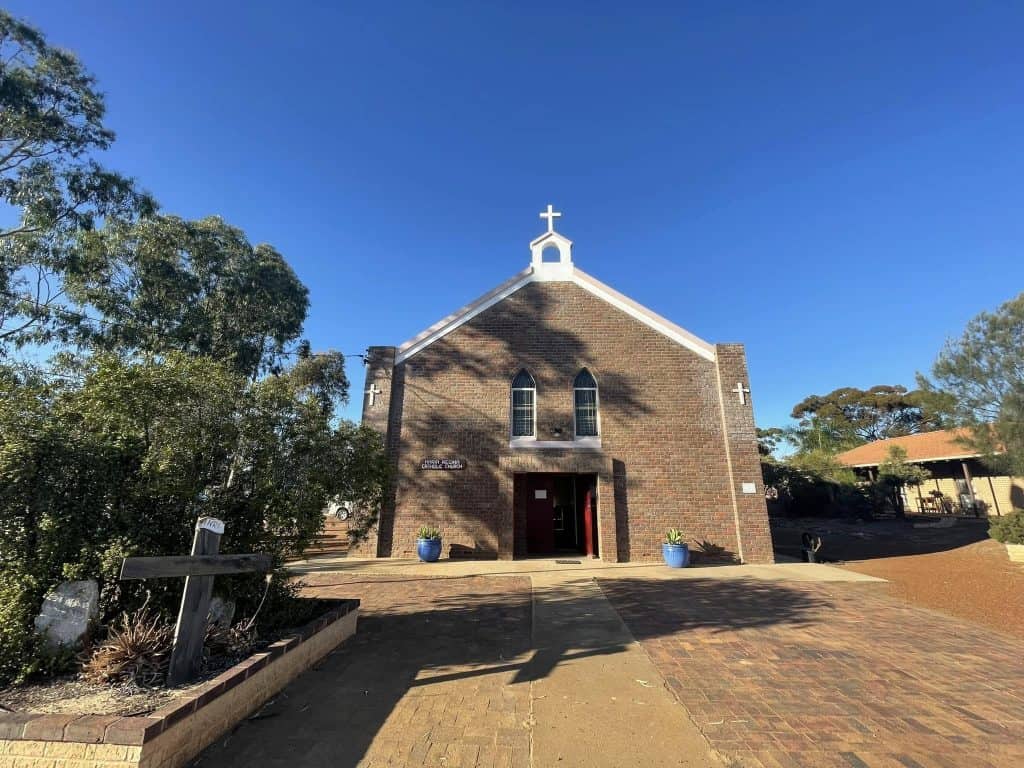
Bunbury Catholic Diocese church building with clear blue sky.

Sunday Mass:

Sunday –  8:00 AM

Other churches administered by Lake Grace Parish:

Hopetoun – First Sunday –  4:00 PM

Kukerin – Second Sunday – 10:00 AM 

Lake Varley – First Sunday – 11:30 AM

Lake Grace

The town takes its name from the nearby lake named after the wife of the then Surveyor-General, F.S. Brockman. The town is over 300 kms east of Bunbury and is the centre of a wheat and sheep farming area. The parish encompasses a large area with Mass centres from Kukerin to the West with its Church of St. Thomas Becket to Hopetoun in the East with its Church of St. Peter the fisherman. The church in Lake Grace is under the patronage of St. Maria Regina. The Catholic community in the Lake Grace district was served from Wagin until March 1957. Father Moloney visited the district on his motor cycle in the year 1912, which was probably the best means of transport at that time. His successors in Wagin served the area at regular though rare intervals. Except for sick calls the district was visited about twice yearly until the 1930s. From then until after the Second World War it received a visit every three months. Mass was celebrated in the public hall and the priest went on from Lake Grace to the other centres east. This was the regular pattern of the life of a country priest in many districts in those days. He left his presbytery on Sunday and did not get back home again for perhaps a fortnight. As the years went by the Catholic community grew in numbers and looking back one must admire the zeal and the devotion to duty of the priests who served this district. Eventually Mass was celebrated once per month, then fortnightly and, after 1953, every week. The need of a church in the district was obvious to both priest and people and the Rev. J. J. O’Mahony took the work in hand. On 31.7.1955 Maria Regina Church was opened and blessed by his Lordship, the Bishop of Bunbury, Most Rev. L.J. Goody. Incidentally on the same day St. Thomas of Canterbury Church in Kukerin was also opened and blessed. Both churches were built to accommodate 150 people in comfort, but one wonders if they will be adequate in another decade. It was now only a matter of time until his Lordship made a new parish east of Wagin. The obvious centre of the new parish was Lake Grace. It was still very large in area but this thriving town was a convenient centre, so in March 1957, Fr Fitzgerald was appointed as the first Parish Priest. The Catholic Presbytery was acquired in 1960. It was formerly the home of Mr & Mrs L.K. Joy.

This is a very hard ask as many many people have contributed in no small way to the building up of our church here in Lake Grace. It has been told to me that as far back as early 1930s Howard Trevenen, as secretary for the Lake Grace area (which was then part of Wagin Parish) fund raised every year by organizing a Bachelors and Spinsters Ball. This provided the means to purchase the two blocks on which the church now stands. The tradition of the Annual Catholic Ball in one form or another survived and continued to raise money for the needs of the church for another 40 or so years. Our present faith family owes a debt of gratitude to our forebears whose faith they handed down to us. Some still in our community are descendents of: Ted & Win Naisbitt, Mollie Nolan, Tess & Phil McGlinn, Edith & Phil Trevenen, Esther & Jim O’Neill.

Patch Story

Description
The Road – symbolizes the many kilometers our Parish consists of and the ten centres within these 260kms from
Kukerin through to Hopetoun. It also symbolizes the commitment needed by our Priests, Religious and Laity in
living out our faith for others and ourselves.

Chalices and Hosts
Symbolizes each of our Parish centres and the location of each.

Church in Foreground
Symbolizes St. Thomas A’Beckett Church in Kukerin where our parish begins.

Cross at End of Road
Symbolizes St. Peter the Fisherman’s Church at Hopetoun with the blue symbolizing the beautiful ocean.

Green Background, Wheat and Sheep
Symbolizes the main industry within our Parish and community as a whole.

Blue Patches
Symbolizes the many lakes within this region hence the name of Lake Grace.

Designed by
Margaret Carruthers, Anne Slarke, Genevieve Curtin & Lee-Anne Trevenen. Made by Lee-Anne Trevenen.

PARISH PRIEST

Rev. Fr. Manoj George Moolamthuruthil, HGN

Exterior view of Bunbury Catholic Diocese church with garden and palm trees.

Sunday Masses:
Saturday (Vigil) – 6:00 PM

Sunday – 8:30 AM

Weekday Masses:
Tuesday to Friday – 9:00 AM 

Reconciliation:
Saturday – 5:00pm


Leschenault Parish – History

For over 130 years, from 1850 until the mid 1980’s, the Leschenault area was part of the parish of Bunbury and sometimes Dardanup.

Until the 1970’s Mass was celebrated in a small building at the top of the Leschenault estuary, along Cathedral Avenue. The building was originally built as a Roman Catholic provisional school in 1875. The priests came from Bunbury to celebrate the Mass in the chapel until about 1916, and then from Dardanup for the next 18 years, until taken over again by Bunbury in 1934.

Some of the priests to visit and celebrate the Mass in those days were Dean Martelli, Father Deleaney and in the 1930’s Father O’Grady and his horse Wee Bobby are fondly remembered.

Max Rodgers, now of Brunswick, was an “altar boy” at the church for 24 years. Max continued to serve at Mass into the 1960’s, well past his boyhood, because “no one else knew the Latin”. Originally constructed of jarrah slabs and a shingle roof, the building was consecrated by Archbishop Redmond Prendiville in 1941 and became known as The Church of St John Vianney. By the 1960’s the Catholic population near the Church was such that it was no longer practical to use the use the building for Masses. It fell into disrepair and was finally demolished in the 1970’s.

Due to the revival of Masses at Eaton and Australind in the 1980’s, the present site was purchased with substantial bequests from pioneering families such as Paddy Rodgers, Johnny Dunne and the Travers family, the sale of the land where the original church stood and also a private donation.

When Leschenault Parish was formed in 1986, a decision was made to build a school before a church because the area and the parish were growing. A Catholic school and Mass centre were built and Fr Pat Rooney was installed as Parish Priest.

Planning for a new church began in 1989 with the construction beginning in 1991. The new building is a steel structure, externally clad in limestone, with a metal roof and internal oregon ceiling. Donnybrook stone tiles are laid in the entry and sanctuary floor. Jarrah seating and altar furniture round off the Australian bush flavour.

The new church of “Christ the Living Vine” was blessed and consecrated by Bishop Peter Quinn, Bishop of Bunbury on 10th May 1992.


PARISH PRIEST

Rev. Fr. Roshan Fernando

Deacon 

Iam Lewis

Sunday Masses:
 Saturday (Vigil) – 6:00 PM
 Sunday – 8:00 AM;  9:30 AM; 6:00 PM

Weekday Masses:
 Monday to Saturday – 7:30 AM

Friday – 5:00 PM

Devotions:
Daily Rosary – 6:45 AM 

Friday – 4:30 PM – Adoration

Mount Carmel Adoration Chapel –  8:00 AM – 7:00 PM (daily, excluding public holidays)

Reconciliation:
Monday – Friday after Mass

Saturday – after morning mass and before vigil mass

And by Appointment

\]

Vision Statement.

As Disciples of Christ, we are a faith-filled, inclusive, connected Catholic family committed to grow, worship and serve.

Mission Statement.

To be a welcoming Church using its talents in Ministries to develop our Parish Community focusing on our spiritual growth.

Parish History

The Assumption of the Blessed Virgin Mary

According to Roman Catholic theology and Catechism, the Virgin Mary, the mother of Jesus “having completed the course of her earthly life, was assumed body and soul into heavenly glory.” This means that Mary was transported into Heaven with her body and soul united. The feast day recognizing Mary’s passage into Heaven is celebrated as The Solemnity of the Assumption of the Blessed Virgin Mary by Roman Catholics.

This doctrine was dogmatically and infallibly defined by Pope Pius XII on 1 November 1950 in his Apostolic Constitution Munificentissimus Deus.

Feast Day

The patronal Feast of Mandurah Parish is celebrated on the 15th August with a Solemn Mass followed by a social get together in the Parish Centre.  The Novena in preparation for the feast begins on the 6th of August.

History of Our Lady’s Assumption Catholic Parish

When the first Mass was celebrated in Mandurah is unknown, we do know however that Mandurah was part of the Pinjarra parish when the first priest Father John Fahey was appointed to Pinjarra in 1909. Mandurah was one of the many Mass stations Fr Fahey served, and he travelled mainly on horseback. He visited other such as Yarloop, Waroona and Harvey, by train. Mandurah was a small village of about 400 people.  The majority of workers were in fishing families who supplied Perth and Fremantle with 80 per cent of the “wet” (that is, fresh) fish used.  Mandurah was part of the Murray Road Board.  Pinjarra was the main centre of the Murray area with all government offices there, Police, Electoral office, hospital etc. As there were busy timber mills at Holyoake, Banksiadale and Dwellingup, the last named was the economic centre of the Hills district.  The Forestry Department maintained a large centre at Dwellingup.  Mandurah was isolated on the coast with very poor communications, with roads of gravel and sand. When the first census was done of the Murray Mandurah area in 1891, there were 701 Anglicans and only 252 Roman Catholics. The first indication of the intention to establish a parish in Mandurah appears in a letter dated May 30th 1934 from the Perth Archbishop Redmond Prendiville, referring to purchasing of land in Mandurah. Blocks 44 & 45 “Cockburn Sound Location”, the present church stands on Lot 44. Due to financial difficulties in the early 1940’s Lot 45 was sold.

first presbytery- Churchill Ave 1955


Churchill Ave 1955

Mandurah was lucky enough to have Sunday Mass from Christmas day until the end of the school holidays and then until Easter, once a fortnight, and during the winter once a month. Sunday Masses required readying one of two centres, the Hotham Valley Hall (now Foreshore Real Estate on Pinjarra Rd) or the Capitol Theatre (Cnr of Sutton St and Pinjarra Rd).  Timetables for Mass in Mandurah appeared in “the Record” only during the summer months in the 1940s. 

first church 1956


First Church 1956

As Mandurah was moving towards becoming a parish in its own right, a momentous event in the history of the Catholic Church took place.  On November 1, 1950 Pope Pius XII declared as dogma the Assumption of our Blessed Lady.  Although no documentary evidence can be found to prove it, those were parishioners at that time believe that the decision was then made to name the proposed parish, “Our Lady’s Assumption Parish”.  It is also believed that Mandurah would be the first in this Sate to bear this title.

From 1949-1952 the parish priest in Pinjarra, and was still travelling to Mandurah to say Mass. With the end of the war, several changes took place, petrol rationing was eased, giving people more mobility, and so the holiday population grew. From 1952-56 there were  only 20 or so parishioners, were wage earners, the small remainder were pensioners or part-time residents.  The only help gained was -the Diocese would pay for the land acquired in Churchill Avenue but the final cost would be borned by Mandurah Parish if and when it came into being.  The debt of the church to be started in the immediate furture could be serviced by the Mandurah congreagation through the Pinjarra parish.  The parishioners started fundraising events, to try and lessen the strain, with things like raffles, bazaar’s, catholic balls, fete’s etc.  The campaign to raise money persisted for many long years.

In 1952 the dream of a church became a reality.  It was built on the site of the present church, Lot 44 Creery Street.  The contractor was Mr Stan Costello.  Because it was to serve as a school during the week, it was designated a ‘school/church’.  However, the Presentation Sisters did not begin to use the building for a school until the first tem in 1955. The first Mass in the church was celebrated  during the Midnight Mass of Christmas in 1952.  The pews were made by Jim Byrne, Wally Weeks, Bill McGeogh, Keith Firns, Ray Gray and Ross Kirkpatrick.   Only five pews were completed in time for the first Mass, and they used tilly lanterns for lighting.

His lordship Bishop Goody blessed and opened the church on 4th January 1953. 

Plans for a school were visioned for the future, but in the meantime the Presentation sisters travelled to Mandurah once a month to teach religious classes at the convent. The first Baptism conducted was on November 14th 1954, and the first wedding was on the 8th February 1955. The first Confirmations recorded were on the 20th November 1955 with a mere 6 children being confirmed.

The Presentation Convent School.   This is the address summarising the history of Presentation school in Mandurah, which was presented by Sister M Carmel Loubere, PBVM, on April 21, 1983 at the official opening of the Assumption Catholic Primary School on Gordon Road.  “The School was opened at the commencement of the first term of 1955 in the Parish Church, which was converted weekly on Sunday after Mass into two classrooms.  The first roll call of students for the church was 40 students, of all ages and denominations. The older students learnt Typewriting, book-keeping, shorthand, and English, art and needlework. Sr M Assumpta Forest was in charge of the school, and her co-worker Sr Carmel Loubere taught music at the convent after hours.  The school continued like this until 1959 when tragedy struck the sisters of the convent, with a boating accident that lost four lives, Sr Patricia, Sr M Finbarr, Sr M Joachim and Father Gerald O’Hara who had come from Iona to spend a holiday in Mandurah.  On the face of this the school was temporarily closed for a period of two years.”

The Catholic Ladies guild was formed in 1965, which was later renamed CLAG. The St Vincent De Paul was established in 1978, and stays vibrant ever since. The church was finally debt free, when the blocks of land in Churchill St were sold. Work then began on constructing the new church.  In 1968 the church continued on by purchasing Lot 63 Pinjarra Rd, realising it would be an ideal spot for the presbytery, as it was directly behind the church. On January 1st 1969 the new church of Our Lady’s Assumption was blessed and opened by Arch Bishop Goody. By 1975 a bigger church was needed as Mandurah’s population was thriving. Extensions on either side were soon erected to accommodate for this. A Parish Council was elected in 1976, and in December 1976 Bishop Peter Quinn visited to induct the parish councillors and to bless the new Presbytery at 63 Pinjarra Rd.

In 1975 the church boughtLot 65 Pinjarra Road.  The old asbestos and weatherboard house became the headquarters for the St Vincent de Paul Society. The other half of the church was built and the altar moved to its present position.   In 1977 Lot 43 Creery Street, next door to the church was also bought.  The house was used for parish activities.  A parish centre is planned for this site.  In 1978 Our Lady’s Assumption Mandurah, a decision was made by the Arch Diocese of Perth to place Mandurah in the Bunbury Diocese. 


In the 1980’s Mandurah saw rapid growth from a shire in 1961, to a town in 1987 and received City status in 1990. There was a real population explosion in these years.  The opening of the Assumption Catholic Primary School took place in 1982 on a 10 acre site on Gordon Rd.  During the 1986 census, parishioners took a survey of the whole district and all known Catholics were entered on a database at the parish.  

The property at 4 Stevenson Street was bought for the Presbytery in 1991, and Mandurah Catholic College opened in 1992 with 50 students in year 8. The school at Coodanup Dr was not completed in time for the opening, and for a short time students had their lessons in the church once again.  Extensions were made to the western side of the church in the mid-eighties and to the eastern side in 1990/1991.

Deacon Frank Nieman and his wife Jean moved from Bunbury in 1995, and has been serving this parish and surrounding areas tirelessly since then.

Two lovely additions to the church were made in 90s.  In 1993, Our Lady’s shirine with lighting and stained glass.  In 1994, the stained glass memorial window dedicated to the three nuns and priest who lost their lives on the Peel Inlet.

The Parish Centre and Parish Office were blessed and opened by Bishop Quinn on 12th June 1998, at 3/65 Pinjarra Rd.   

Three Discalced Carmelites from Kerala (India) took over the administration of the parish on the 26th of January 2012. 

carmelites with bishop


from left: Fr Albin Odippattil, Fr Theophane Antony, Bishop Gerard Holohan, Fr Xavier Mathirappilly, Fr Anson Akkappilly

Fr Albin was appointed as the Administrator of the Parish on 7 September 2025.  Fr Bony Reberra OCD and Fr Jijo Rockey OCD were assigned as Associate Priests to continue the parish pastoral ministry. 
PARISH ADMINISTRATOR

Rev. Fr. Albin Odipattil, OCD

ASSISTANT PRIESTS

Rev. Fr. Bony Rebera, OCD

Rev. Fr. Jijo Rockey, OCD

DEACON

Rev. Michael Philips

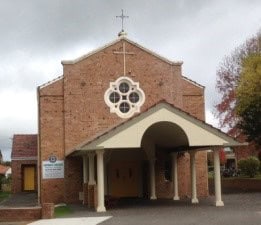
Bunbury Catholic Church building with brick facade and circular window.

Sunday Mass:

Saturday (Vigil) – 6:00 PM
First, Third and Fifth Sunday –  10:30 AM
Second and Fourth – 8:30 AM
Reconciliation:
Saturday – 5:15 – 5:45 PM 

Manjimup Parish – History

 Click for more → Historical info_Manjimup parish

The first Manjimup parish church was opened by Archbishop Clune on 6th September 1914 just as World War I broke out. With many of the menfolk at war the congregations decreased, but Father Jeremiah Reidy continued to travel from Bridgetown by sulky (and later in a Model ‘T’ Ford) to say Mass in Manjimup once a month.

Manjimup developed due to the prospect of work, building timber mills, felling and milling timber.

Manjimup became a separate parish in March 1922 with the appointment of Father Kearnan. There being no residence for a priest in Manjimup, Father lived in Bridgetown during the week going to Manjimup to say Mass on the weekends.

With the area growing rapidly and using a bequest left by a former parishioner, a Philippine Islander, Thomas Menrique, a half acre of land was bought across the road from the recreation ground, for the building of a convent. This not being enough for the children to play on, options were taken to buy four adjoining blocks still in their virgin state. Fallers from nearby Dean Mill brought the bigger trees down and busy bees of parishioners cleared sufficient land for the convent. A residence was built which was first to serve as the presbytery and later as a Sisters’ convent. The Sisters of St Joseph arrived in April 1923.

The biggest problem with schooling was that few of the Catholic children lived in the town itself. This meant provision had to be made for boarders. To accommodate the borders a verandah was added to the Convent using one end for beds and the other end for a dining room. While still living in Bridgetown, Father Kearnan busied himself making tables, cupboards, blackboards and desks out of Shell petrol cases. To give the Sisters daily Mass, Father Kearnan left Bridgetown to live in the sacristy an unlined room at the back of the church in Manjimup. Manjimup Convent School opened on 16th April 1923.

A new brick, two storey building was opened late in 1925. This comprised of four classrooms downstairs and dormitories upstairs. The old church was sold to a family who then provided new material for building the school. Mass was then said in the passage of the convent rows of two chairs ran the length of the passage, the altar crammed against the back door

Starting in May 1927 children were brought in from outlying State schools to Manjimup to enjoy school holidays in the Convent whilst receiving sacramental instructions from the Sisters.

In 1955 anew church was blessed and officially opened by Bishop Goody.  Extensions continued to the school with the blessing and opening of Kearnan High school in 1972.   Kearnan College, catering for children from Kindergarten to Year 12, is now a modern well equipped school. With the departure of the Sisters from Manjimup, a lay Principal was appointed to the school in 1994. The old convent building has been refurbished to become the administration building for the school.

In more recent years we have seen the building of a magnificent Parish Centre. This comprises several meeting rooms, hall, office, consulting room, kitchen, outdoor atrium area, resource room and toilet facilities. It is a truly wonderful asset for this parish and used extensively by the parish, the school, diocesan groups and other non-profit making organisations.

PARISH PRIEST
 
Rev. Fr. Joseph Sousa
Exterior view of St Thomas More Church in Bunbury with signage and garden.

Sunday Mass:

Saturday (Vigil) –  6:00 PM

Sunday – 10:00 AM

Weekday Masses: 
Tuesday, Wednesday, Thursday, Friday – 9:00am

Reconciliation:  Saturday – 5:30 PM


SHORT HISTORY

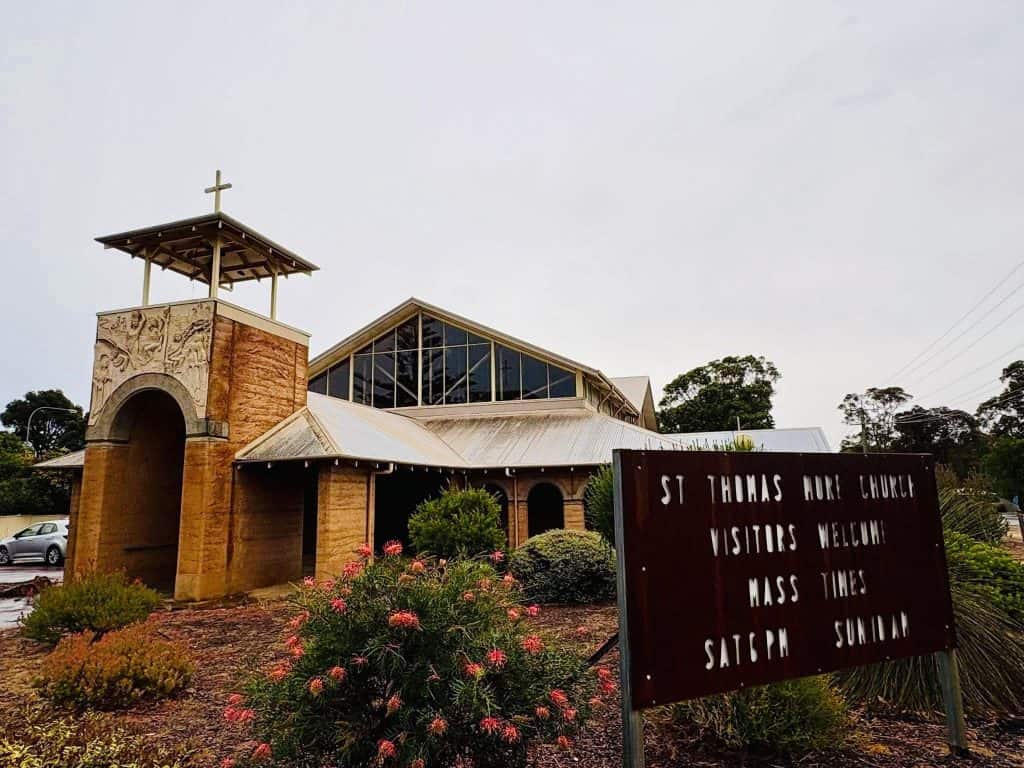
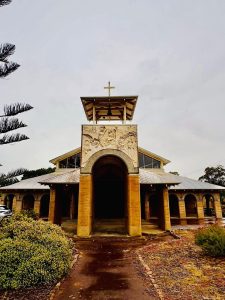
The original St Thomas More Catholic Church was built in Cowaramup in 1936 and later in 1939 it was re-located to Margaret River, on the corner of Tunbridge and Farrelly Street.  As the population in the district increased, there was a need to build a bigger Church. The building of the present Church began in January 1982, and completed for the official opening on the 31st January 1983. 

PARISH PRIEST

Rev. Fr. Joeffrey Arceta, OSJ

Sunday Masses:

Sunday – 10:00 AM 

Weekday  Masses:
Tuesday – 5:00 PM

Wednesday 9:00 AM

Benediction:

Tuesday – 4:30 PM

Wednesday – 8:30 AM

Reconciliation:
Second and Fourth Sunday –  after Mass

First Friday – before and after Mass

Tuesday and Wednesday – Before and After Mass


Mount Barker Parish – History

The earliest recorded history of priests living in this area was in February 1846, when five French priests set out from Fremantle to establish a mission for Aborigines at Lake Mollyalup. They left two years later, after great deprivations and the mission a failure. Very few Aborigines were found.

1850-1860: During these years there were periodic visits by travelling priests. Among these were Bishop Sena, Canon Martelli, Father Griver and Garrido, all Benedictine Monks.

1860: The area southwards from Williams was formed into the Albany Parish, with a Benedictine, Fr Coll, as resident Parish Priest. The spiritual needs of Catholics were met by this priest, riding through miles of virgin bushland to bring the consolation of the sacraments to the lonely, isolated settlers.

1870: The Sisters of St Joseph of the Apparition arrived in Albany. Soon after this, Mount Barker children were taken to Albany for religious instruction, often staying several weeks and being confirmed there.

Early 1900’s: Around this period, Mass was said in the local hall, the priest travelling from Albany by train, staying overnight, saying Mass the next morning, carrying out various religious duties during the day, and returning to Albany later by train. The children were taught the elements of their religion by their parents and classes of religious instruction were given b Mrs McNamara, Mrs Mulkerin and later, by a postal clerk, Michael McEncroe. This Michael McEncroe subsequently became a missionary priest.

1910: Mr Francis Collins donated the land on which the present church is built and he and Constable McNamara, George Enright, an orchardist and Mr Corbett, a schoolmaster, contributed towards the erection of a small church. A subscription list was opened by Francis Collins and the first donor was an Anglican, Mrs P. Wright from “Narpyn’ who gave a gold sovereign.

1914: A small church, the first Sacred Heart Church, was opened in Mount Barker by Archbishop Clune. Fr Gilroy (later Dean) travelled from Albany to celebrate Mass once a month.

1920: In the early 1920’s, Edward Collins made local history by going to Rome to study for the priesthood. Monsignor Edward, as he was known locally with affection, served the church faithfully in various districts of Western Australia until he died in Perth in 1964, mourned not only by his family but by Mount Barker people as their first Mount Barker born priest.

1936: Some extensions were made to the church.

1937: The Mount Barker/Denmark Parish was formed.

1938: The Cranbrook Catholic Church was built. The land for the church site was donated by the current station master at the time, Mr O’Donnell. Money required to build the church was raised by the parishioners from Cranbrook, Tenterden, Frankland and Pootenup. Fund raising ventures included the Catholic Ball, donations, etc., which continued after the church was built to pay off the debt. 

1941: The Mount Barker Presbytery was opened. Four Sisters of St Joseph of the Apparition took up residence in Mount Barker They lived in a small cottage and taught in the church until the school was opened in 1947 and the Convent in 1951. The Sisters made important contributions to the town. They taught academic subjects, commercial subjects and music, besides giving Christian education. The Sisters also visited outer centres giving religious instructions as well as conducting periodic courses in Mount Barker for children of outlying districts.

1947: St Joseph’s school opened.

1951: The Convent was opened and when closed by the Sisters in 1971, it became a home for the Frail Aged and renamed Redman House, The building is currently the Student Hostel.

1954:  Mount Barker became part of the newly formed Bunbury Diocese.

1958: First Mass for the Catholic community of South Stirling and the surrounding districts, was celebrated in the home of the Easton family on l2th July. Home Masses continued to be celebrated monthly until September 1961, when Masses were moved to the newly completed South Stirling Hall. Prior to the 1960’s, parish finances had been somewhat haphazard, much work and fund raising by priest and laity, but it was felt that a more business-like approach to parish finances should be adopted. 

1960: On 28th March,  the original mission site was rediscovered at Lake Mollyalup which the Spiritan Fathers had named Sancta Maria.

Mr Roger Sounness, then owner of an adjacent property to the mission site enquired of many old inhabitants in the area. One, the late Mr Bob Parsons, then in his 70’s, recalled that as a child playing with native children, they were forbidden by the older natives to play on the little knoll because the holy men had lived there”. On that site on 28th March 1960, they found two small mounds of stones and one, when excavated turned out to be an old fireplace. Digging out the ashes, they found two sets of beads, one a rosary of the Seven Dolours and the other, a conventional rosary, on the metal Crucifix of which was stamped the figure of Our Lady and the words: “Mere de Dieu Priez Pour Nous’ (Mother of God Pray for Us). The beads and the inscription gave ample proof they had found the site of “Sancta Maria”.

In October, during the centenary celebrations of the Albany church, a Pilgrimage was made to the old mission site. The Diocesan Bishop Rev L.J. Goody, Abbot Gomez of New Norcia, followed by a large crowd composed of Sisters, Brothers, clergy, parishioners of Albany, Mount Barker, Cranbrook and surrounding areas, as well as local settlers and members of local historical societies, made their way on foot (for about half a mile) to this hill top where an open air service in memory of the missioners was held. At this date (1960) the State Government offered a portion of this land (about 500 acres) to the church, with the stipulation that it should be used within five to six years. It was hoped to establish a church Agricultural school there, but as church authorities were unsuccessful in this aim, the land was reverted to the crown.

1962/63: The Frankland church was built and opened.

1962: South Stirlings became part of the Gnowangerup Parish until 1982.

1965: Extensions were made to the Presbytery.

1966: Rebuilding of church began. In the early 1960’s there were many Catholics living in this area and the church was far too small. The decision was taken to build a new church. This was commenced in 1966 and completed in 1967, with Mass being held in the Plantagenet Hall for the period of construction.

1967: On l7th June 1967, the new church was blessed and opened by Bishop Goody. As much as possible of the old church was incorporated in this new church. The sanctuary wall of the old church became part of the north wall. Mount Barker stone was used for a feature wall, this stone providing a contrast to the almost stark appearance of the church. The Stations of the Cross were a gift from a young man who offered to paint them. The frames also were made and donated by another young man. (Both of these young men were from Pardelup Prison Farm and their work and gifts were appreciated by the parish.)

1997: On the 6th April, a Diocesan Pilgrimage to “Sancta Maria” at Lake Mollyalup to celebrate the 150th Anniversary of the mission was led by Bishop Peter Quinn. He offered an “open air” Mass at the original site. Also present for the historic ceremony was the Superior General of the Holy Spirit Fathers from Rome and the Provincial Superior from Ireland together with a number of Spiritan priests. A large crowd of parishioners attended from different parishes.

PARISH ADMINISTRATOR

Rev. Fr. Edcel Silva, OSJ